Brewed in Blood
Inherited Grounds

Akira was eight years old when she discovered coffee smelled like her father.
Not the coffee itself. She thought coffee tasted awful. He had once let her sip from his mug after an entire morning of asking why adults drank something that smelled so good yet tasted like a bitter way to die. The face she made nearly cost him the rest of the cup.
What she loved was everything around it.
Making coffee was a ritual. Almost a language. The scrape of a scoop through a paper bag. Beans rattling into the grinder. The click of the switch. That low mechanical growl filling the kitchen before the rest of the house had properly woken up.
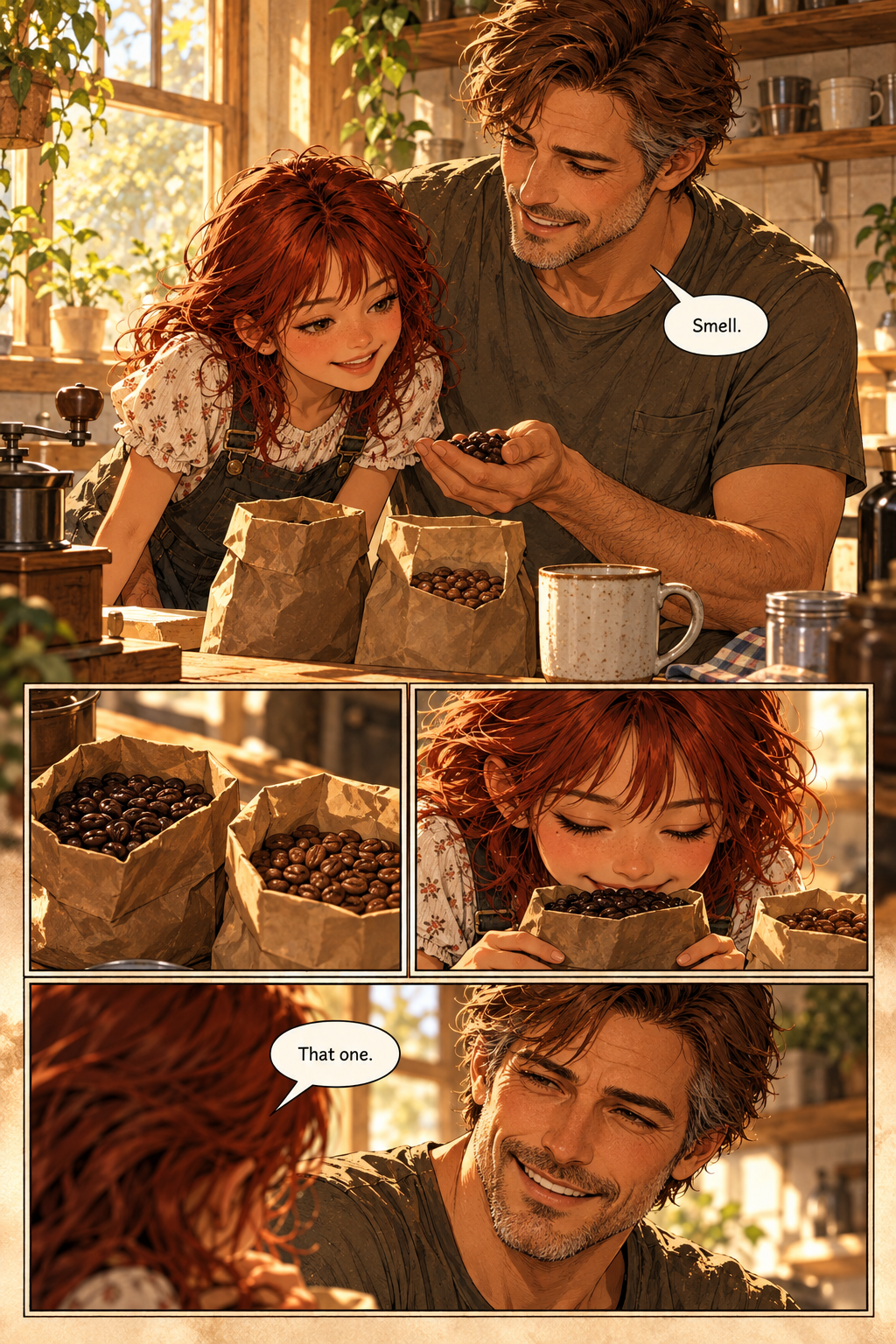
That morning, her father set two open bags in front of her.
“Smell.”
Akira leaned over the first and wrinkled her nose.
“That bad?” he asked.
“It smells burnt.”
“Technically, it’s roasted.”
She stared at him. “That’s burnt.”
He laughed. “Okay. A little.”
The second smelled softer. Sweeter. She didn’t know words like cocoa or caramel yet; she only knew she wanted to smell it again.
“That one.” She pointed.
Her father nodded. “Good choice.”
Akira looked at him. “Was it the right one?”
Her father shook his head. “There isn’t a right one.”
“There has to be.”
“Nope.” He smiled.
Akira frowned at the bags. “Then which one’s better?”
“That depends who you ask.”
“I’m asking you.”
He smiled. “I like both.”
Her face told him that answer was useless.
He nudged her bag closer. “There’s the one you like.”
“So that one’s mine?”
“If you want it to be.”
That made more sense.
While the coffee brewed, Akira stole a napkin and drew a koi on it. The body was too round, one fin was bigger than the other, and the tail had taken three tries.
Her father leaned over her shoulder. “Pretty good.”
“You’re lying.”
“Only a little.”
She was still smiling when her mother entered with Akira’s math workbook.
The warmth didn’t disappear. It just got quieter.
“You haven’t finished these.”
“I was going to,” Akira said, already looking down.
“You were going to yesterday too.” Her mother set the workbook beside the napkin. “Twelve problems. Your reading log. And your vocabulary list before tutoring tomorrow.”
“It’s Saturday.”
“Yes. And?”
Akira glanced at her father for help. He suddenly found his coffee fascinating.
Her mother folded her arms. “Saturday is still a day.”
He hid a smile behind his mug.
“Don’t encourage her, William.”
He took another sip. “I’m drinking coffee.”
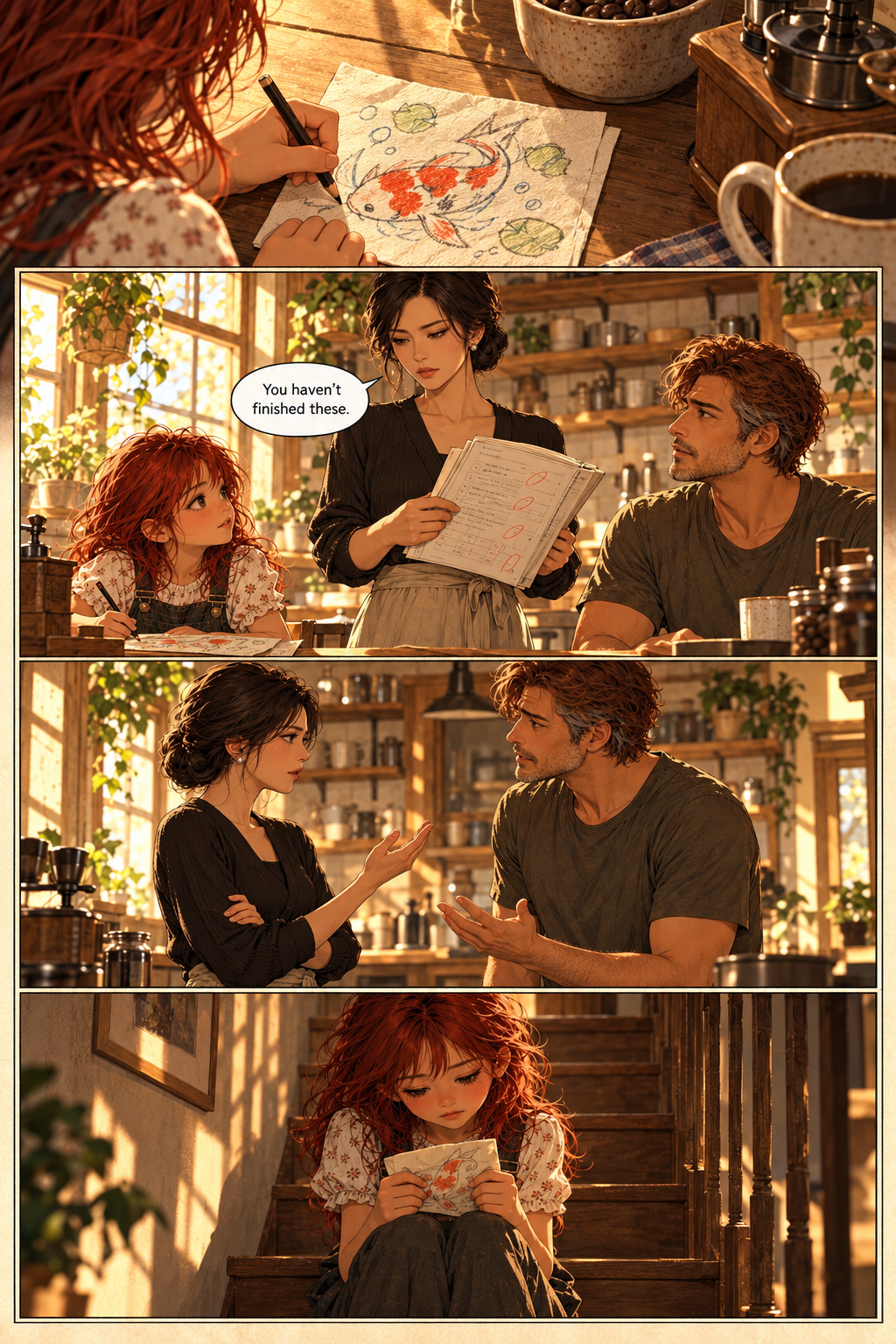
“You’re laughing.”
“I can do both.”
She gave him a look. “William.”
He lowered the mug. “Come on, Nori.”
“You always do this,” she snapped, and the smile left his face.
Her mother turned her attention back to Akira, who was still sitting there, and tapped the workbook. “Finish these. Reading log too. Then you can draw.”
William nodded toward the workbook. “She can finish them later.”
“She has had later since yesterday,” Nori said.
“She’s eight.”
“And she won’t be eight forever.”
Nori looked at Akira.
That was enough.
Akira slid off the chair. At the doorway, William called her back and nodded toward the napkin she had left behind.
“Keep the fish.”
She smiled, grabbed it, and headed upstairs.
She was supposed to go straight to her room. Instead, she stopped when her parents’ voices carried from the kitchen.
They weren’t yelling. That was almost worse.
“She’s bright, William. You know she is.”
“I know.”
“Then stop making me the bad guy for expecting something from her. She gets bored, you tell me she’s eight. She doesn’t finish something, you tell me she’s eight.”
Akira sat on the top stair and folded the napkin between her fingers.
“She has opportunities I never had,” Nori continued. “I’m not going to watch her waste them.”
William’s voice softened. “I know you want her safe.”
“I want her prepared.”
“And I can want more for her without deciding what more has to look like,” her father argued.
“And if what she wants is wrong?” Nori asked.
“Your idea of wrong is the problem. If she makes a mistake, it’s still hers to own.”
Akira stared at the koi until their voices dropped too low to follow.
Later, William found her cross-legged on her bedroom floor with unfinished fractions scattered around her.
“Mom already knows what I’m supposed to be, doesn’t she?”
He stopped in the doorway. “That’s a pretty big question for somebody avoiding fractions.”
“I’m taking a break.”
“Ah.” He crouched beside her. “Your mom wants a lot for you.”
“That means yes.”
He laughed softly. “Kind of. She gets to want things for you. So do I. But you get to want things for yourself.”
“What if it’s different?”
“Then it’s different.”
Akira looked at him. “That’s too easy.”
“I didn’t say it’d be easy.”
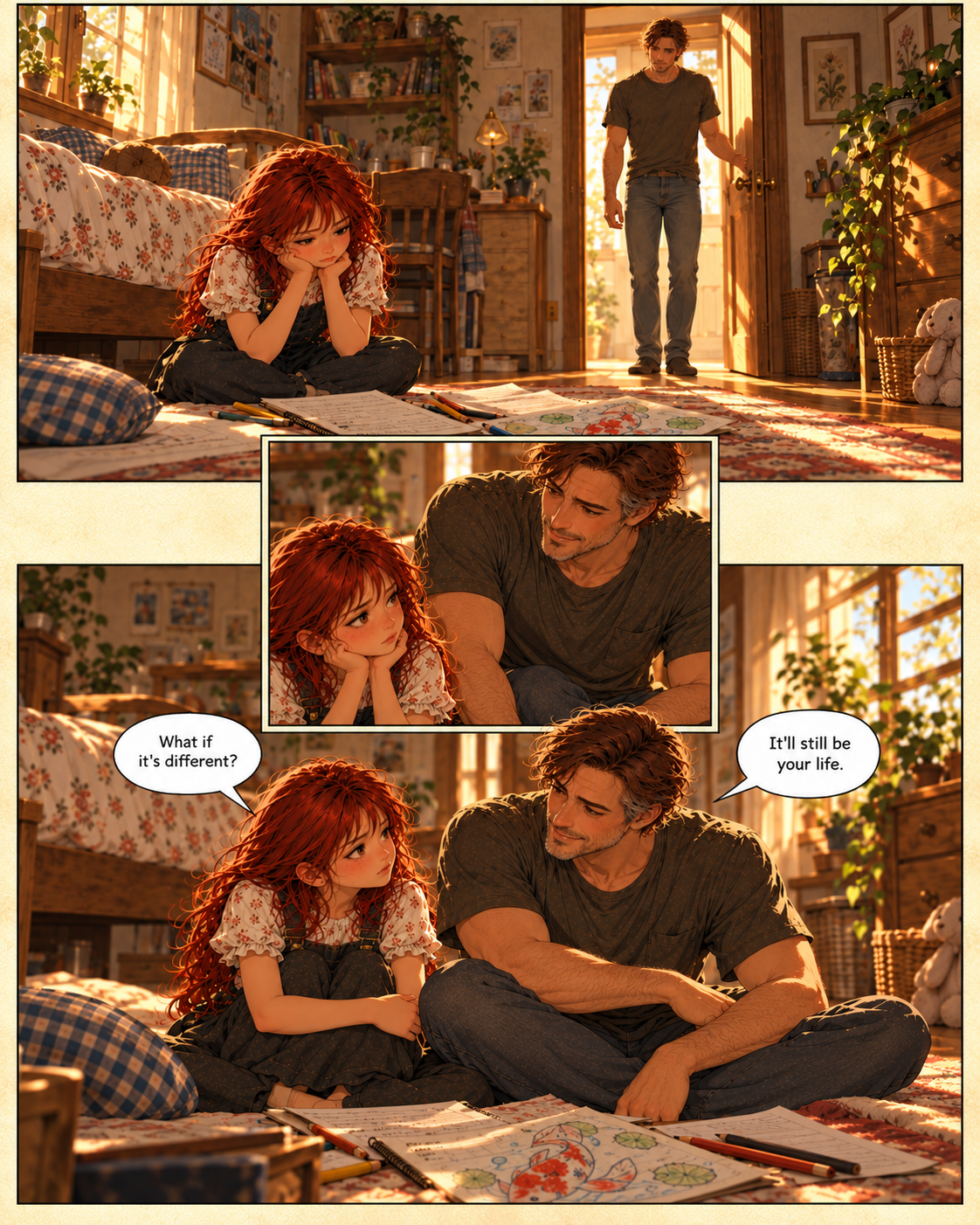
He tapped the crooked koi. “But it’ll still be your life, kid.”
Years later, Akira would forget the fractions, the vocabulary list, even which bag of coffee she chose.
She never forgot that.
It’ll still be your life.
After her father died, the house filled with ordinary things nobody quite knew what to do with. His chair. The cupboard he always reached into first. The chipped ceramic mug he loved.
The argument in that kitchen never really went away either. It just grew up with Akira.
Her mother still believed safety came from discipline, achievement, and the right choices. When Akira finally made the choice her mother had spent years steering her away from, the one person who would have understood was gone.
Across town, Kenji and Ryu Takahashi were learning a different definition of choice.
Kenji was thirteen, old enough to know that when their father called for both of them, whatever waited on the other side of the door was never just what it looked like.
Ryu was nine, and still young enough to hope otherwise.
Their father was waiting beside a shogi board. Their mother sat a few feet away, quiet and composed. She didn’t always attend these lessons, but when she did the boys noticed. Sometimes her being in the room was enough to remind their father that there were limits.
Ryu glanced at her as they came in. She gave him the smallest smile, and he almost smiled back before Kenji caught his sleeve. “Not now.”
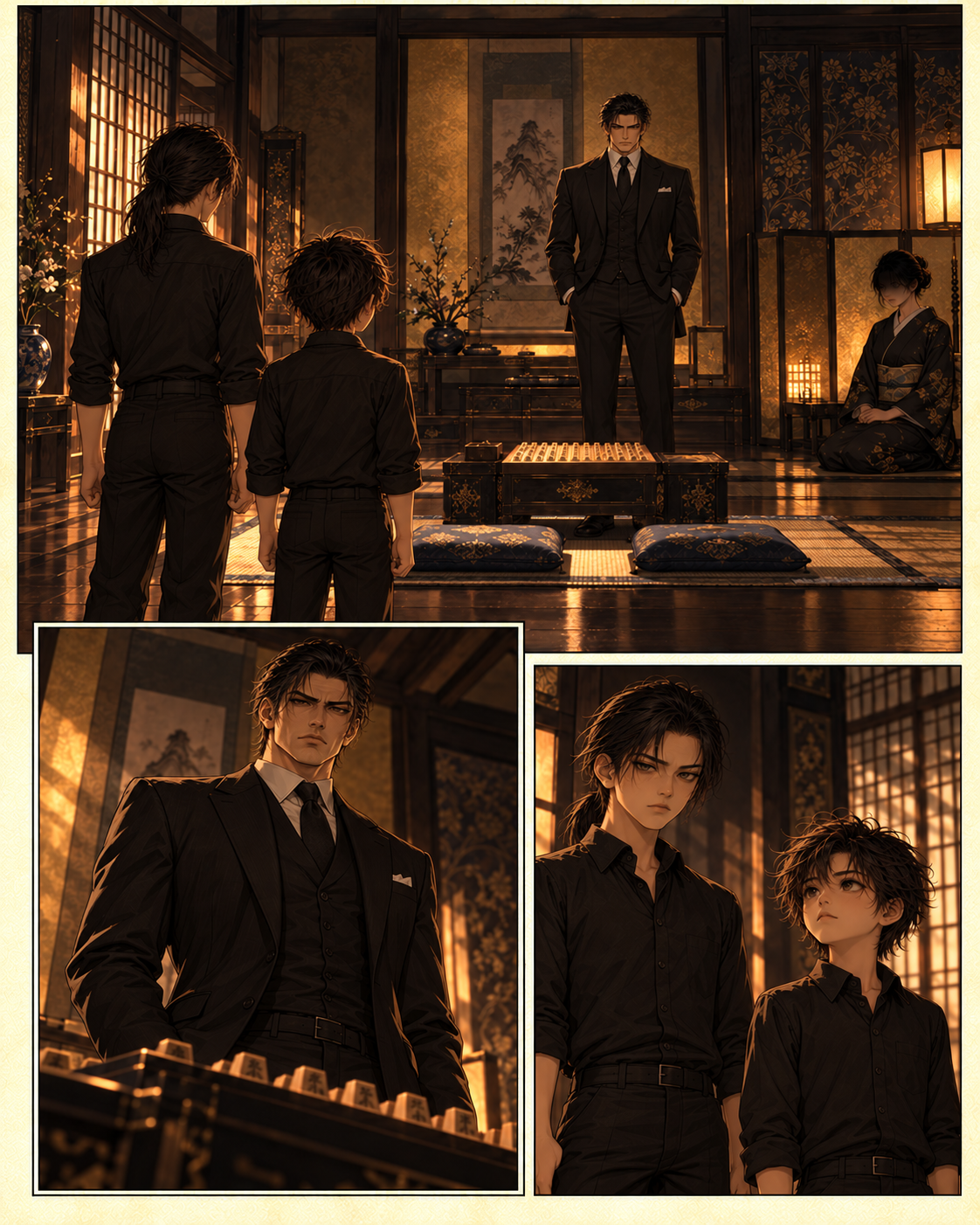
“Sit,” their father demanded.
Ryu looked at the board, then at their father. “Are we supposed to—”
Kenji nudged his knee under the table.
“What do you see?” their father asked.
Ryu leaned forward and pointed almost immediately. “There.”
Kenji saw it too, but he also saw the trap waiting behind it.
“Wait.”
Ryu groaned under his breath. “Why?”
“Just wait.”
Kenji moved one piece.
Ryu stared at the board for another second, and then his face changed. “Oh.”
“Now.”
Ryu took the opening and Kenji finished the sequence.
Checkmate.
Ryu sat back looking pleased with himself. “I found it.”
“You almost ruined it.”
“I didn’t.”
“You were about to.”
“But I didn’t.”
“Because I stopped you.”
Ryu frowned at him. “I still found it first.”
Their mother lowered her eyes, trying not to smile.
Their father wasn’t smiling at all. “Who saw the opening?”
“I did,” Ryu said quickly.
Kenji looked at him. “You were going to move the wrong piece.”
“It was right there.”
“And you didn’t see what was behind it.”
Ryu’s frown deepened. “I would’ve figured it out.”
“No, you wouldn’t.”
“Yes, I would.”
Their father let them go back and forth for another moment before speaking.
“Ryu.”
Ryu stopped.
“You saw an opening and wanted to take it before it disappeared.”
Ryu looked at the board again. “It was a good opening.”
“It was. And if your brother hadn’t stopped you, you would have walked straight into the trap behind it.”
Ryu went quiet.
Their father turned to Kenji. “You saw the same opening.”
Kenji nodded.
Their father looked at Kenji a little longer this time. There was no warmth in it, but there was approval. “But you waited.”
“I wanted to see what happened.”
“No.” Their father’s voice stayed flat. “You wanted to know what would happen before you moved.”
Kenji didn’t answer.
Their father reached for the pieces and began putting the board back into position.
“Again.”
The second game took longer. Ryu tried very hard not to move first just because he saw something.
He still did. Kenji still waited.
When it was over, their father said nothing about who had done better. He simply sat back and looked at them for a moment, and Kenji knew the game had never really been about winning. Ryu was still looking at the board.
On the way out, he bumped his shoulder against Kenji’s.
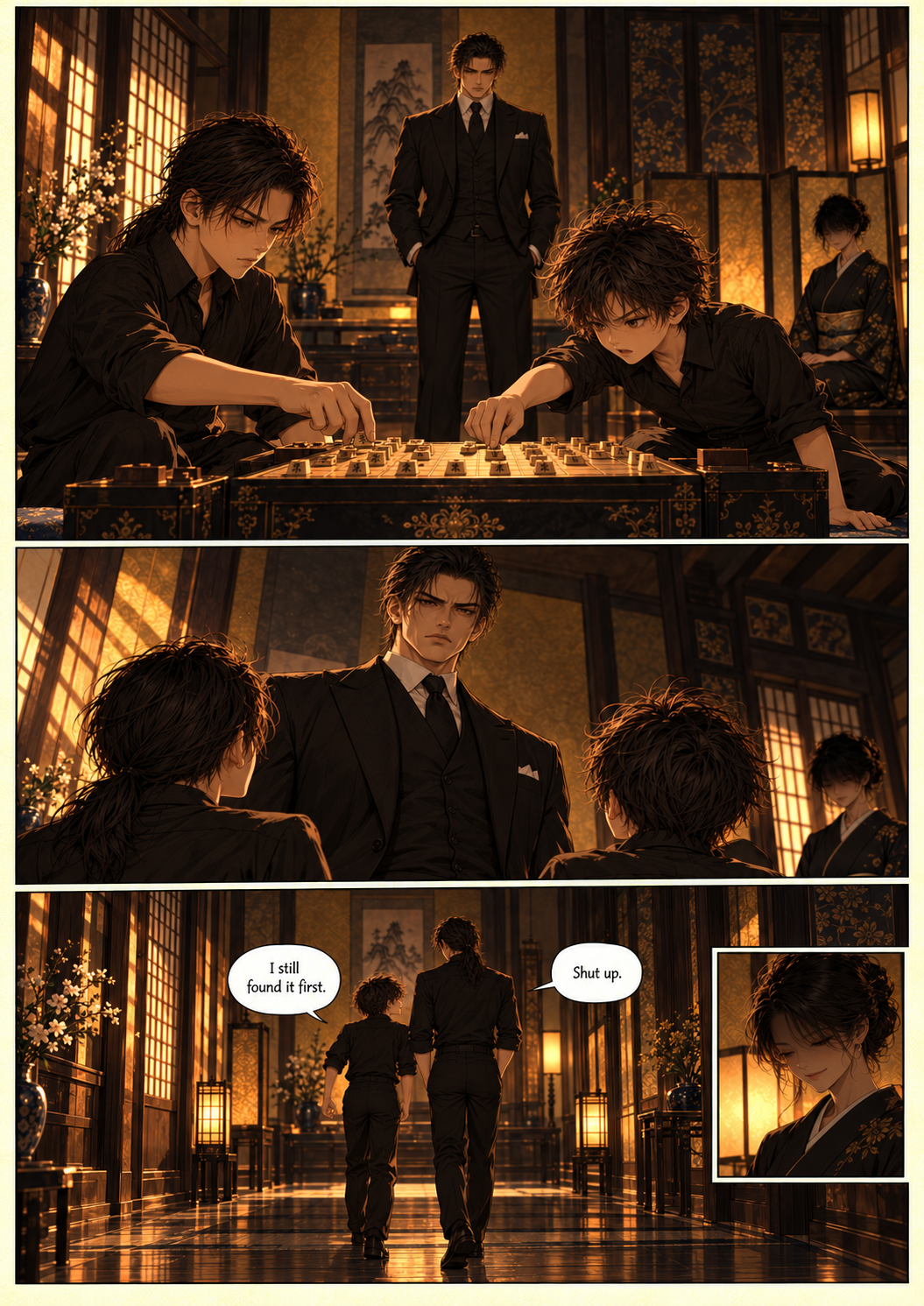
“I still found it first.”
Kenji glanced over. “You still almost messed it up.”
“Shut up.”
Kenji’s mouth twitched.
For a few steps, they were just brothers again.
Their mother watched them go.
Her expression stayed composed but her eyes didn’t.
A few days later, their father called them to the training room.
That part wasn’t strange. The boys had trained for years, with instructors and with each other, so Ryu walked in expecting more of the same.
“If you hit my face, I’m telling Mother,” he warned Kenji.
Kenji looked at him. “You tell Mother everything.”
“Because she likes me.”
“She feels sorry for you.”
Ryu shoved him.
Kenji shoved back, but not hard enough to start anything.
Their instructor was already there. So was their mother.
Then their father told the instructor to leave.
Ryu stopped smiling.
Their mother stood. “What are you doing?”
“On the mat,” their father ordered.
Kenji moved first. Ryu followed a second later.
“They trained this morning,” their mother said.
“They’ll train again.”
“With an instructor,” she added.
“Not right now.”
There was nothing unusual about the words by themselves. It was the way he said them that made Ryu look at Kenji again.
Their father turned toward the boys.
“Fight.”
Ryu waited a second, like maybe there was more coming, but there wasn’t.
“How long?” their mother asked.
Their father didn’t look at her. “Until one stays down.”
Ryu laughed once.
It came out wrong. He looked around, but nobody else laughed.
His mother stepped forward. “No.”
That finally got their father’s attention.
“They are your sons, Kenzo.”
“I’m aware.”
“Then don’t make them prove it like this.”
For a moment he just stared at her.
“No broken bones,” he said.
“Kenzo.”
The way she said his name made Ryu look at her.
She wasn’t asking anymore.
Their father’s expression changed, but only slightly. “That is enough.”
It wasn’t, and everyone in the room knew it.
Their mother looked at the boys instead. “Stop when you can.”
Their father heard her but he didn’t argue.
“Begin.”
At first, it almost did feel like any other spar.
Ryu came in fast. Kenji waited for him to overcommit. When Ryu landed on the mat, he pushed himself up on one elbow and scowled.
“You’re slow.”
Kenji looked down at him. “And you’re on the floor.”
Ryu rolled his eyes and got back up. “That doesn’t mean anything.”
For a second, Kenji looked like he might smile.
Their father said, “Focus.”
Whatever ease had been left in the room disappeared with it.
They knew each other too well for the fight to drag on. Ryu knew Kenji liked to wait. Kenji knew Ryu hated waiting for anything.
Usually, someone stopped them before either one had to decide when enough was enough.
This time, nobody did.
Ryu hit the mat again.
He got up, and Kenji put him down a third time, harder than before.
“Stay down,” Kenji said quietly, trying not to hurt his brother any more than he already had.
Ryu stared up at him. “No. You stay down.”
It was such a Ryu answer that Kenji nearly laughed.
Then he remembered their father was watching.
The next time Ryu went down, Kenji kept him there.
Ryu fought the hold at first, angry more than anything, but after a few seconds the fight went out of him and Kenji felt it happen.
Ryu wasn’t trying to win anymore.
Their mother stepped onto the mat. “Enough.”
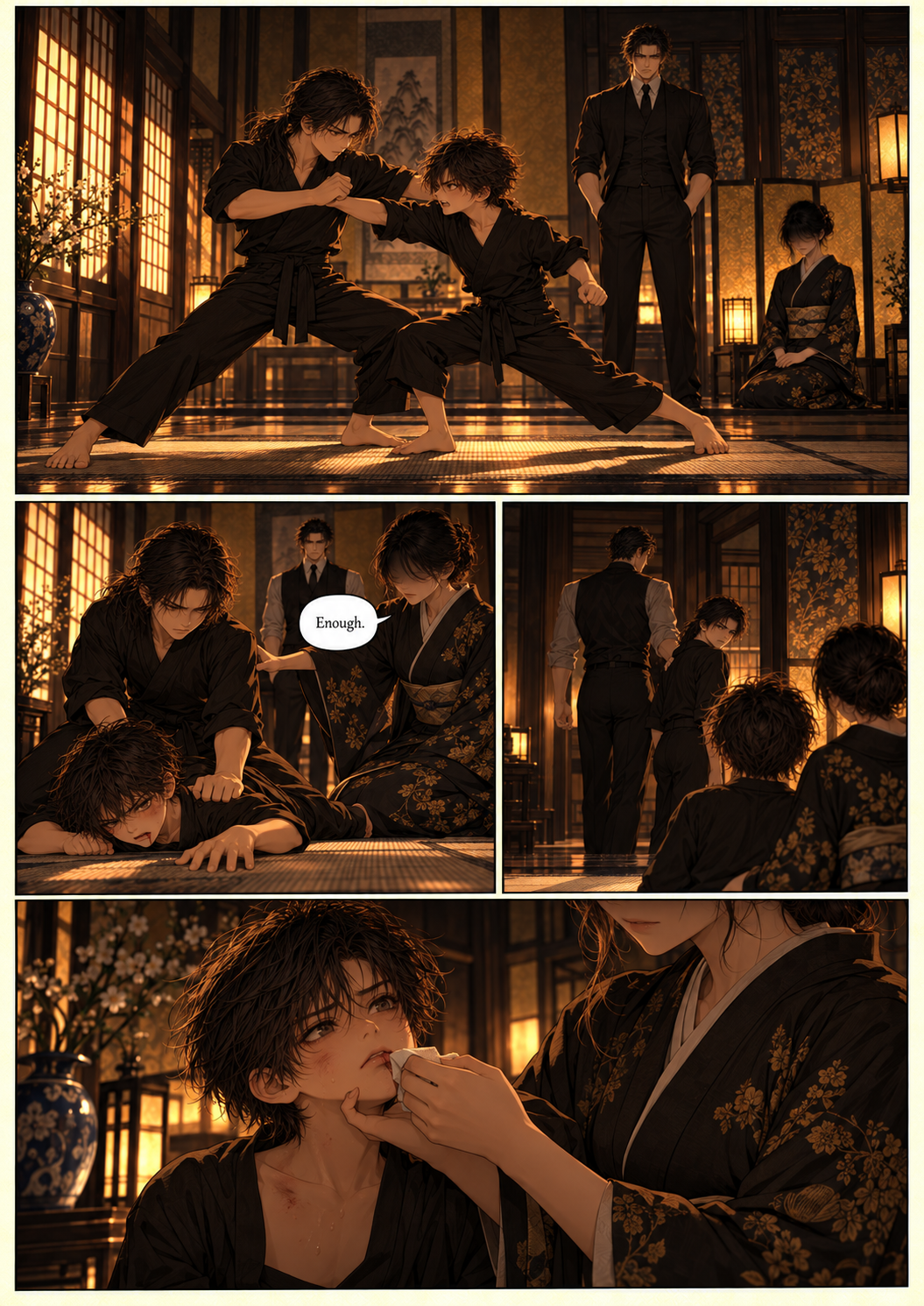
Their father’s eyes stayed on Ryu. “He can still stand.”
“He stayed down,” she pleaded. “Isn’t that enough?”
Their father finally looked at her.
“Move.”
“No, Kenzo. They’ve had enough.”
There was nothing soft in her defiance.
He stared at her for a long moment, then turned to Kenji.
“Get up.”
Kenji released Ryu immediately.
Their father was already walking toward the door. “Kenji. With me.”
Kenji looked down at his brother before following.
Ryu turned his face away.
By the time Kenji reached the doorway, their mother was kneeling beside Ryu, checking the split in his lip.
“Kenji.”
His father didn’t have to call twice, and the office door closed silently behind them.
Whatever was said inside stayed there.
Ryu hissed when the damp cloth touched his lip.
His mother pulled it back. “That was the cloth.”
“It attacked me.”
She looked down at it like she was considering the accusation. “Hmm. Dangerous cloth.”
“I knew it.”
That finally got a smile out of her.
When she tried again, Ryu jerked his head away. “Ow.”
“You’re bleeding.”
“It still hurts.”
“I know.” She caught his chin before he could dodge her again. “Hold still.”
He frowned at her, but he stopped moving.
For a little while, neither of them said anything. Ryu kept looking toward the office door.
Eventually he asked, “Why did he make us do that?”
His mother’s hand slowed.
“Your father thinks competition makes people stronger.”
Ryu stared at her. “That’s stupid.”
She laughed before she could stop herself.
His face brightened immediately. “See?”
“I didn’t say you were wrong.”
That pleased him for all of two seconds, then his eyes went back to the door.
“Kenji knew I was done, Mom.”
“I know.”
“But he still didn’t stop.”
His mother set the cloth down for a moment. “No. He didn’t.”
Ryu’s jaw tightened.
“But Kenji didn’t make the rule.”
“He still listened to it.”
“So did you, Ryu.”
He looked away.
She didn’t rush to fill the silence. She just picked up the cloth again and brushed his hair back from his forehead before checking the cut one more time.
After a while she said, “You’re allowed to be angry with him.”
“I am.”
“I know.”
“And Father.”
“I know that too.”
Ryu finally looked at her.
She held his gaze. “Just remember who put both of you on that mat.”
He didn’t answer, and she didn’t make him.
Instead she stood and held out her hand. “Come on. You need ice before your face gets even bigger.”
Ryu looked offended. “My face isn’t big.”
“Not yet.”
“That’s mean.”
Her mouth twitched. “You’ll survive.”
He took her hand anyway.
When Kenji eventually came out of his father’s office, he found them at the end of the hall. His mother was holding ice to Ryu’s face while Ryu complained about something Kenji couldn’t hear.
Then she laughed.
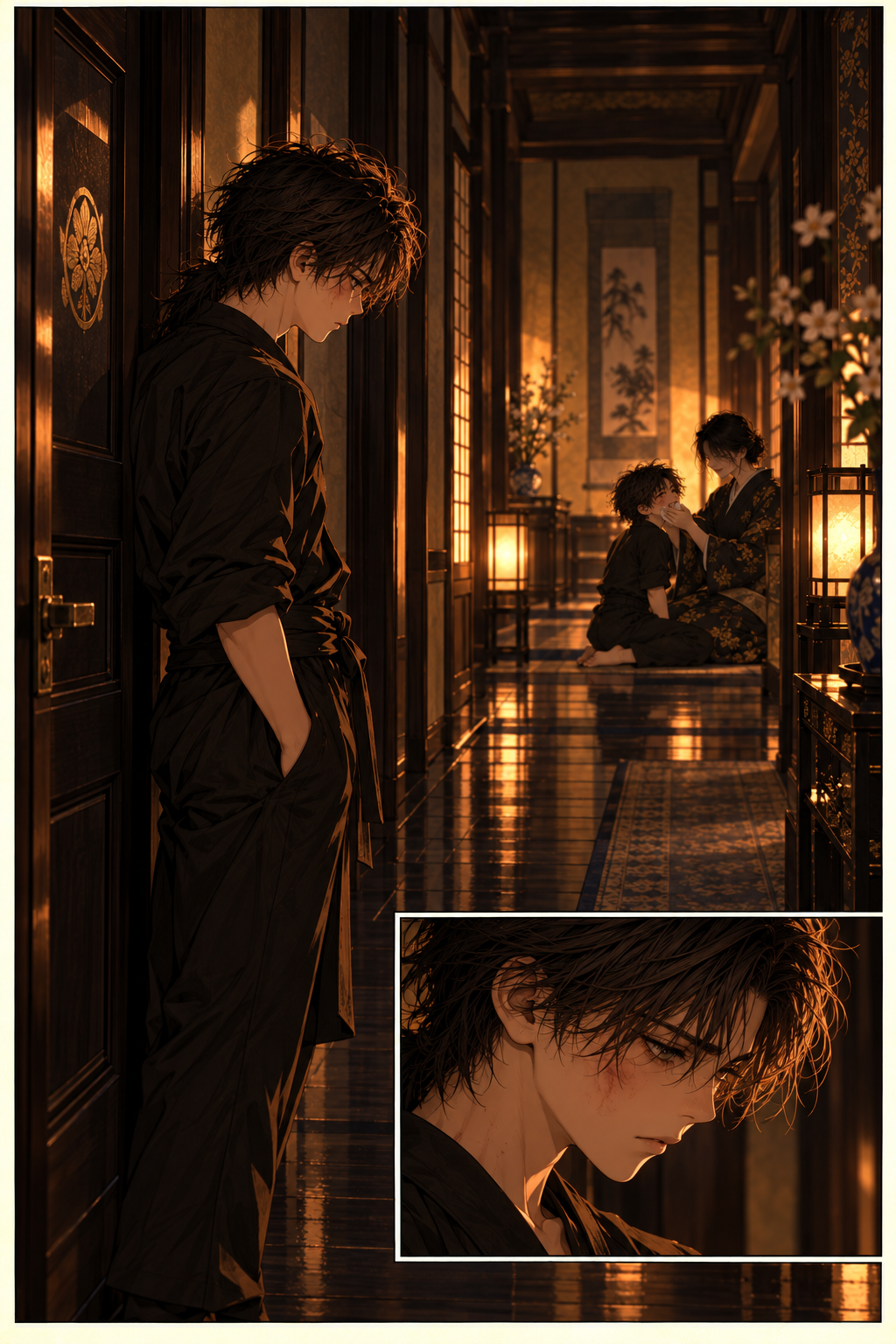
Kenji stopped. He knew why she had stayed with Ryu. His brother was nine. He was hurt. Of course she had stayed.
Knowing that didn’t make it feel any better.
Their father had taken Kenji into the office because he had won.
Their mother had stayed behind and made Ryu laugh.
Maybe that wasn’t what it meant.
At thirteen, it was still what it felt like.
His father had use for him.
His mother had a softness for Ryu.
Kenji stood there for another second, then kept walking.
The key stuck the first time Akira turned it.
Of course it did.
“Kuso,” she muttered, pulling the key back out. When she got irritated enough, Japanese usually came out before English.
She tried again, harder this time, and the lock finally gave.
“See?” Akira pushed the door open. “Threats do work.”
The Sora Koi was still dark and cold inside. She locked the door behind her, dropped her bag beneath the counter, and started waking the place up in the same order she always did: lights, music, front shade, espresso machine. She had tried changing it once and spent the entire morning feeling like she had put her bra on over her shirt. Never again.
Amber light warmed the counter while the plants in the windows continued their ongoing competition between thriving and dramatic near-death. Apparently owning a cafe also meant running a botanical emergency room.
On her way past the entrance, Akira straightened the maneki-neko. It had shifted half an inch to the left overnight.
“You have one job.”
The ceramic cat smiled back at her.
“Yeah, keep smiling. You’re on thin ice.”
Those few minutes before opening were her favorite, before milk started steaming, cups started piling up, and somebody inevitably asked for a cappuccino with no foam. For a little while, The Sora Koi belonged only to her.
Akira tied on her apron and turned toward the grinder.
Then she saw the mug.
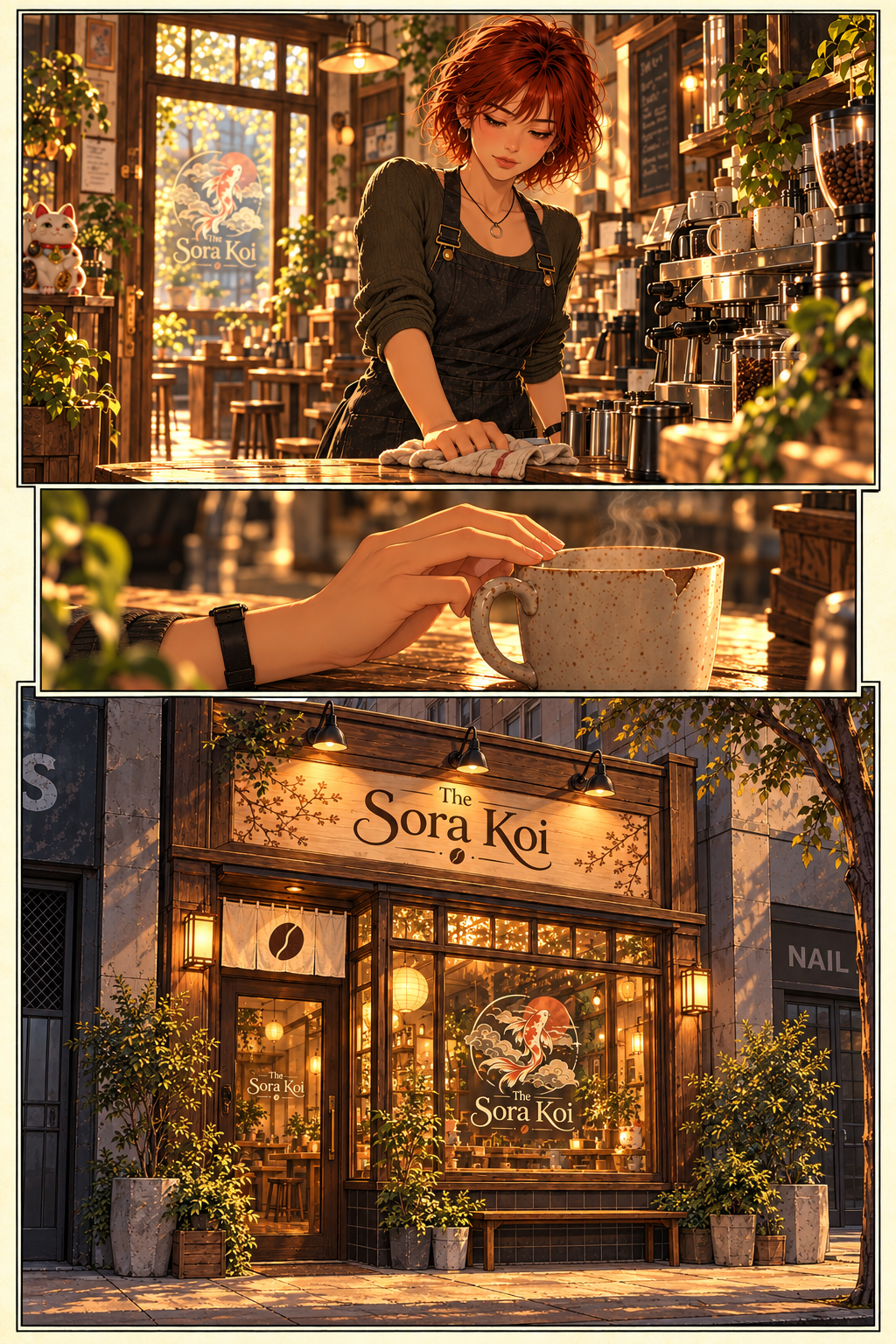
It sat where it always did behind the counter: old ceramic, chipped handle, no matching saucer, useless for actual service. She could have thrown it away years ago.
She never did.
Her thumb passed over the rim, and for half a second the café smelled like another kitchen—sunlight across the counter, paper bags full of beans, her father laughing because she had called coffee burnt.
“There’s the one you like.” His voice cut through the machine like he was standing right there. The memory came gently, which somehow made it worse.
Akira swallowed and took her hand away. “Yeah. I know.”
Then she poured the beans into the grinder. The machine came alive beneath her palm, and the smell spread through the cafe, warm and dark and familiar.
It was close enough to ready, and caffeine could handle the rest.
She flipped the sign to OPEN.
The Sora Koi sat between buildings much larger than it had any business competing with, all concrete, steel, and morning shadow around her little pocket of warm wood, plants, stupidly expensive espresso equipment, and one ceramic cat currently on probation.
Akira had built the place because she wanted something that was hers, somewhere she got to make the choices.
She had no idea how many men in Los Angeles believed otherwise.
No comments yet. Start the conversation.
Join the conversation